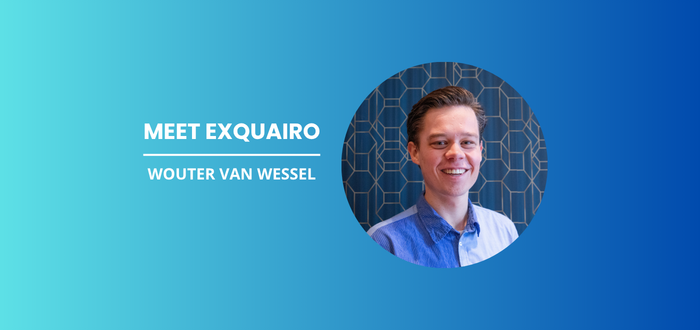
Anyone attending an exquAIro bootcamp is likely to meet him: at the front of the room, in front of a whiteboard filled with model structures, or deep in discussion about research design. Wouter van Wessel is Project Leader Data & AI at Rewire, and through that role he is closely involved with exquAIro. At Rewire, Wouter helps organizations put data and AI to practical and strategic use. “We work with companies and institutions across the whole chain: from identifying opportunities to building and implementing solutions,” he explains. “But always with one goal: enabling organizations and people to create and build the future with Data & AI themselves, through close collaboration and education.”
This vision: collaboration, knowledge transfer, and creating sustainable impact, also underpins the partnership with the UMCG within exquAIro.
Bridging Consultancy, Education, and Research
Wouter contributes to multiple areas of exquAIro. He is a trainer in the biomedical bootcamps, mentors science trainees, advises on program strategy, and serves on the editorial board. “On the education side, I deliver trainings and help shape the programs. Which techniques should be included? What must participants truly master to advance their research? We continuously refine everything,” he says.
The guiding and recruiting of science trainees connects to his own background. During his study Econometrics, Wouter completed a joint traineeship with UMCG and Rewire. In this collaboration with collaborating with researchers and physicians at the UMCG in Groningen, including Gerard Koppelman, co-founder of exquAIro, he researched prediction of allergies in young children based on DNA data. “I was already fascinated by the combination of medical expertise and data science back then. Being part of it now, but as a mentor, makes it even more rewarding.”
From Fundamentals to Advanced AI
In the six-week Biomedical AI bootcamps, Wouter guides participants from foundational principles to advanced applications. “We build the program step by step,” he explains. “From linear and logistic regression to machine learning techniques such as decision trees, XGBoost, and other tree-based models.”
Tree-based modelling uses decision structures to detect patterns in data and make predictions, for instance, about disease outcomes. “We don’t just teach how to apply these models, but when to use which method. In the medical field, interpretability and robustness are essential.”
The program then dives into advanced model optimisation: hyperparameter tuning, handling missing data, cross-validation, external replication, and model selection. In weeks four and five, deep learning and neural networks are introduced, including applications in image recognition.
What makes the program unique is the immediate application of knowledge. “By week three, participants work with their own data in a guided hackathon. It is truly inspiring to see how fast the learnings translate into real practice, for me this is the power of bootcamp.”
Generative AI: Opportunity and Responsibility
Generative AI (GenAI) also plays a key role in the bootcamps. Wouter highlights two major impacts. “First, we can now convert unstructured medical data, like reports, handwritten notes, PDFs, into structured formats. That opens enormous opportunities for research and process improvements.”
Second, generative AI accelerates the research and learning process itself. “Participants can analyse, experiment, and select the right AI models for their research questions faster than ever. But speed also comes with responsibility. You need to understand how a model works, where the risks are, and when a technique is appropriate.”
exquAIro focuses on imparting exactly that insight. “Techniques evolve rapidly, but the underlying principles remain. Understanding them allows researchers to make better decisions when selecting models.”
Innovating Together
What inspires Wouter the most is collaboration. “After spending a few days in Groningen, I return full of energy. The passion and ambition of the physicians and researchers is immense. We bring AI expertise, they bring deep medical knowledge. Together, you reach a higher level.”
He recalls a participant predicting cardiac events using smartwatch data. “After a training on model optimisation, we redesigned her research setup together. Two weeks later, she had already applied it in her ongoing study. That’s impact.”
Always Evolving
As an editorial board member, Wouter and colleagues continuously steer the program’s content. “We constantly evaluate: are we keeping pace with the latest developments? What do researchers need to make a real difference? AI moves fast, and so do our programs.”
According to Wouter, the partnership between Rewire and exquAIro is unique. “We are at the beginning of a fundamental change in healthcare. What exquAIro does has real impact on people’s lives. That motivates all of us as trainers. We share knowledge, but we learn just as much in return.” Or as Wouter sums it up: “This isn’t theoretical innovation. This is building the future of medical care, together.”
Want to know more?
Learn more about exquAIro bootcamps on our website.
Photo: Wouter van Wessel. Photographer: Agnieszka Dworzanska (Poppy Lens).