The fourth class of the exquAIro Biomedical AI Bootcamp has completed its training. At the closing symposium on Friday 18 September, participants presented their work, reflected on the role of AI in their research and received their certificates. The programme also marked the next step in exquAIro’s approach to biomedical AI: supporting researchers not only in developing AI expertise, but also in translating that expertise into new research.
Over two three-week blocks, the participants worked intensively on the application of AI to biomedical research questions. The bootcamp combines methodological training with participants’ own research contexts, covering areas such as machine learning, generative models and working with biomedical data. The closing symposium provided an opportunity to discuss the resulting projects with fellow researchers and faculty, and to consider their potential for further development.
For Gerard Koppelman, chair of exquAIro, this transition from education to research is central to the programme. “The value of biomedical AI expertise ultimately lies in what researchers are able to do with it in their own scientific work. We therefore want the bootcamp to be more than a training programme: it should enable researchers to formulate meaningful AI-driven research questions and assess where these approaches can contribute to biomedical discovery.”
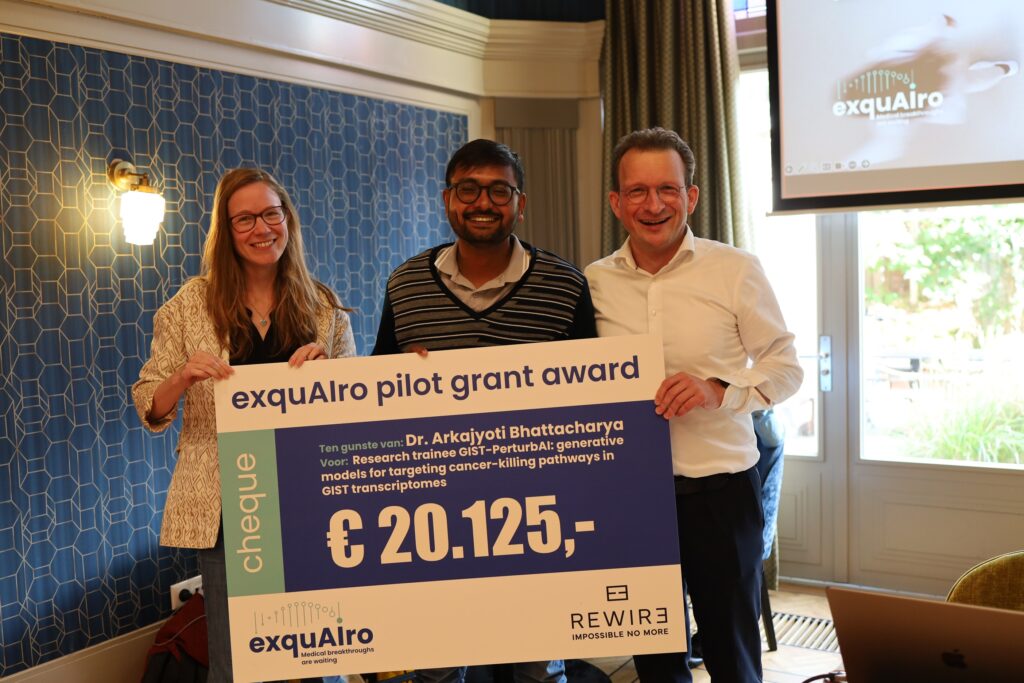
Pilot Grant awarded to Arkajyoti Bhattacharya
One way exquAIro facilitates this next step is through its pilot grant programme. The grants are intended to provide seed funding for promising AI-driven research projects that can generate initial evidence and potentially form the basis for larger follow-up studies.
This year’s pilot grant has been awarded to Dr. Arkajyoti Bhattacharya, Biomedical AI expert and Senior Researcher in the Department of Medical Oncology at UMCG. His project, GIST-PerturbAI: generative models for targeting cancer-killing pathways in GIST transcriptomes, focuses on gastrointestinal stromal tumour (GIST), a rare cancer for which the limited and fragmented availability of transcriptomic data makes systematic target discovery challenging.
The project will use a conditional generative model to perform large-scale in silico perturbation screening of GIST transcriptomes. By virtually activating or repressing genes, the researchers aim to identify perturbations predicted to induce cancer-killing or growth-suppressive pathway programmes. The most promising hypotheses will subsequently be tested in selected GIST cell lines, creating a direct link between computational prediction and experimental validation.
“What makes this project particularly interesting is the opportunity to test whether a generative AI framework can help prioritise experimentally relevant hypotheses in a rare-cancer setting,” says Bhattacharya. “The pilot funding allows us to connect computational screening with focused experimental validation, and to generate the evidence needed for further development of the approach.”
The project receives €20,125 in exquAIro funding, with additional support for a research trainee/data scientist supported by Rewire, and focused wet-lab validation. Its intended outputs include a GIST-specific benchmark, an adaptive perturbation-screening framework, a validation dataset and a GIST perturbation atlas.