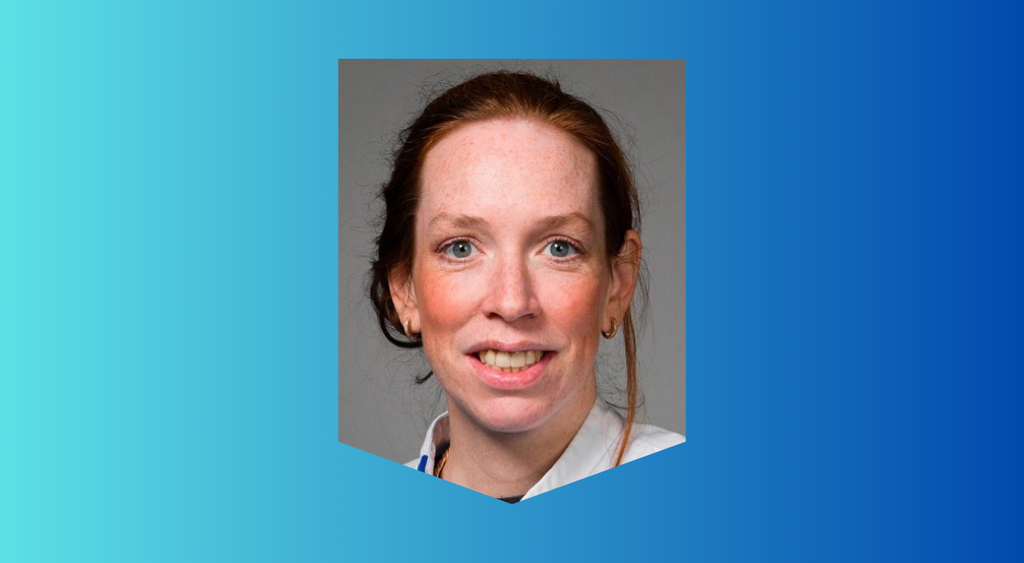
When radiation oncologist Kristel Muijs (UMCG) noticed that traditional predictive models were increasingly reaching their limits, she decided to deepen her understanding of artificial intelligence. She joined exquAIro’s Biomedical AI Bootcamp at a time when her involvement in the national AI4Health consortium was taking shape. Today, she contributes from UMCG to several oncology use cases within this ten-year national programme, with the knowledge gained during the bootcamp helping her to participate as a clinician on equal footing in discussions on AI developments.
“I think AI is inevitable,” says Muijs. “For medical research as well as for future healthcare. As a clinician, I want to understand what the possibilities are, but also its limitations.”
AI in the treatment of oesophageal cancer
Muijs works as a radiation oncologist at the UMCG and treats primarily patients with oesophageal cancer. Her research focuses on predicting complications following chemoradiotherapy and surgery. At present, these predictions mainly rely on multivariable regression models. Although such models remain valuable, Muijs also recognises their limitations.
“You often have much more information available than can be incorporated into a traditional model,” she explains. “Think of imaging data, 3D radiotherapy dose information and other patient characteristics. AI offers opportunities to integrate these complex datasets much more effectively.”
Her research group is therefore increasingly exploring deep-learning approaches to further improve predictive models and ultimately tailor treatments more closely to individual patients. Such models may, for example, help identify patients who are most likely to benefit from innovative treatment modalities such as proton therapy.
An AI-driven patient journey
Within AI4Health, Muijs and her colleagues focus on automating parts of the oncology patient journey for patients with head and neck or oesophageal cancer. This brings together a range of AI techniques, from the automated extraction of information from electronic health records to deep-learning models for tumour segmentation and radiotherapy planning.
“Prospective oncology registries contain large amounts of clinical information, but collecting these data is very time-consuming,” says Muijs. “One of the projects within AI4Health therefore investigates how data can be automatically extracted from electronic health records using large language models (LLMs).”
The group of Rudolf Fehrmann is also working on AI applications for multidisciplinary team meetings (MDTs), where future AI agents could support clinicians in treatment decision-making. Several developments are also taking place within radiotherapy itself. Algorithms already exist that automatically delineate critical organs surrounding the tumour on medical scans. Within AI4Health, the group aims to develop similar models for the automated segmentation of tumours.
“That could lead to a tremendous efficiency gain,” says Muijs. “We increasingly adapt treatments during the treatment course itself. Automated delineation and planning would make those adjustments much easier. In addition, our group is working on automating the generation of radiotherapy treatment plans using deep-learning models. Predictive models for toxicity and treatment outcomes may subsequently be used to further personalise those plans.”
From clinician to AI contributor
Muijs gained much of the knowledge needed to critically assess and discuss these kinds of applications during exquAIro’s Biomedical AI Bootcamp. “I mainly wanted to gain background knowledge,” she says. “I saw more and more AI projects emerging around me and wanted to understand what researchers are doing, the choices they make and the challenges they encounter.”
The first weeks of the bootcamp were challenging. “I really wondered whether I could do this and whether it suited my background as a physician.” Gradually, that feeling changed. “During the last three weeks, it really started to come alive for me. Suddenly, you begin to see the applications in your own practice and become enthusiastic about what is possible.”
Although Muijs does not see herself as someone who programmes models on a daily basis, she feels that the bootcamp has clearly changed her position within research projects. “I can now participate much more easily in discussions about analyses and models. I ask different questions and can better assess whether certain choices make sense. That helps enormously when supervising PhD candidates and researchers.”
Within her department, AI expertise is mainly concentrated among medical physicists. That is precisely why her combination of clinical experience and AI knowledge proves valuable. “It is fantastic to collaborate with people who have deep technical expertise. But it helps enormously if, as a clinician, you understand AI well enough to actively contribute and generate new ideas.”
Collaboration as a catalyst
For Muijs, collaboration may ultimately be the most important lesson. “We do not conduct research alone. Large consortia such as AI4Health really create a flywheel effect for collaboration. By combining expertise, you can achieve much greater impact and actually bring AI into clinical practice.”
Her advice to physicians and physician-scientists who are still hesitant about exploring AI is therefore straightforward. “Don’t hesitate, just do it. I believe AI will become an essential part of the future of medical research and healthcare. You are better off being involved early.”